Societies Are Growing Older. What Can We Do About It?
Societies Are Growing Older. What Can We Do About It?
Societies Are Growing Older. What Can We Do About It?
(Picture)

(DATE)
JUL 26, 2026
(CATEGORY)
Insights & Thoughts
(Picture)
(Information)
(Information)
Reflections from a Group 54 conversation with Cheng Wan, Postdoctoral Researcher at ETH Zürich
Behind population ageing lie fundamental questions about pensions, care, work and responsibility across generations.
People are living longer. Fewer children are being born. Across much of the world, the balance between younger and older generations is gradually shifting.
This transformation is commonly described as population ageing. But behind this simple expression lies a much wider set of questions about pensions, healthcare, economic growth, family life and the organisation of society itself.
For Group 54’s first online conversation, we welcomed Cheng Wan, Postdoctoral Researcher at ETH Zürich, whose research focuses on population ageing, retirement, health risks, long-term care, fertility and labour.
The discussion offered an introduction to some of the forces behind ageing societies, the challenges they create and the choices that governments, families and individuals may increasingly have to make.
Fewer workers for every older person
One of the clearest ways to understand population ageing is to compare the number of older people with the working-age population.
In Switzerland, there were approximately 6.4 working-age people for every person over 65 in 1950. By 2020, this ratio had fallen to around 3.3. By 2050, it is projected to be closer to 1.8.
Similar developments are expected across Europe.
Japan is already further along this path. Its ratio has fallen from more than ten working-age people per older person in 1950 to approximately 1.8 today.
Japan and Switzerland's changing support ratios:
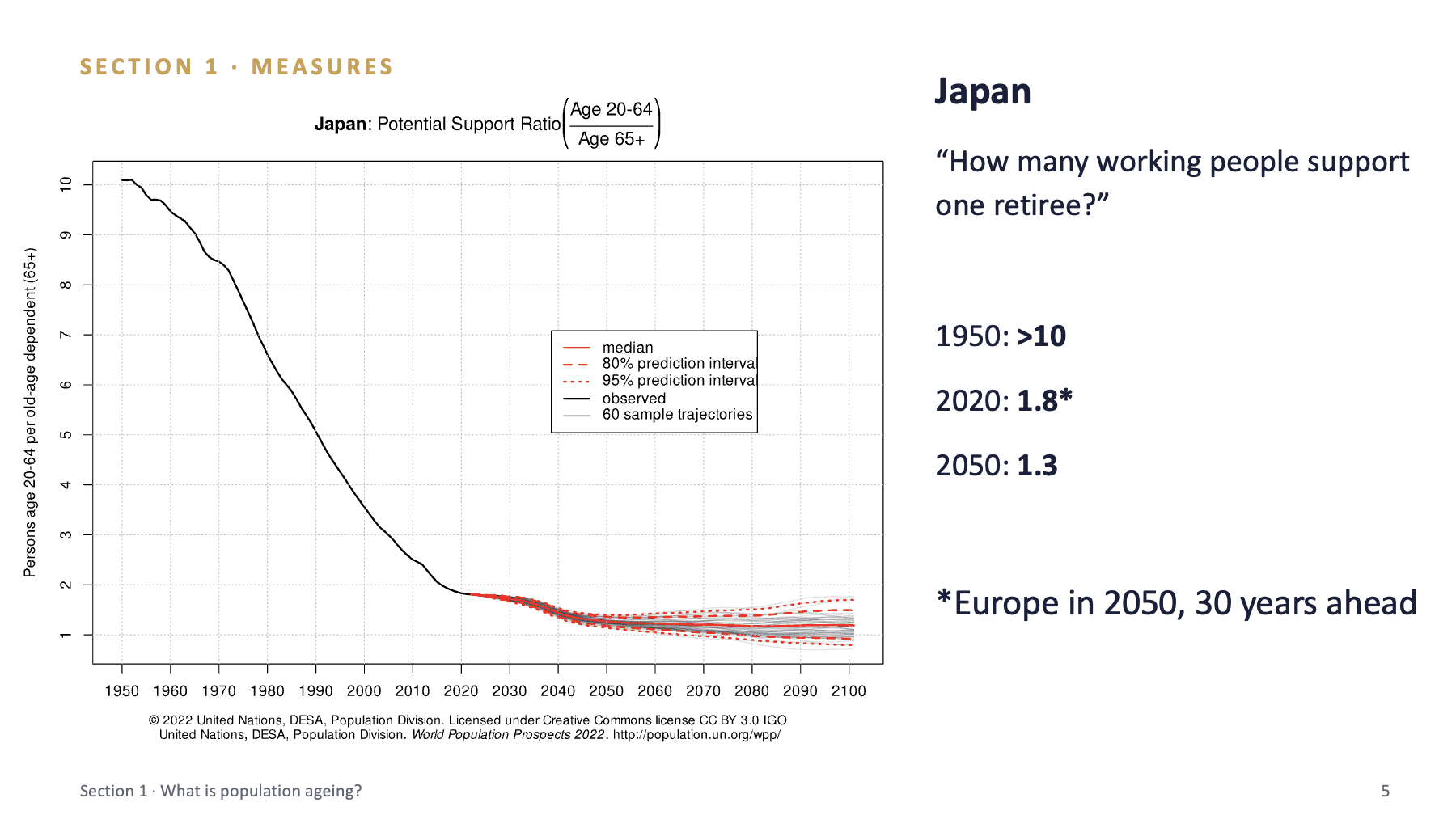
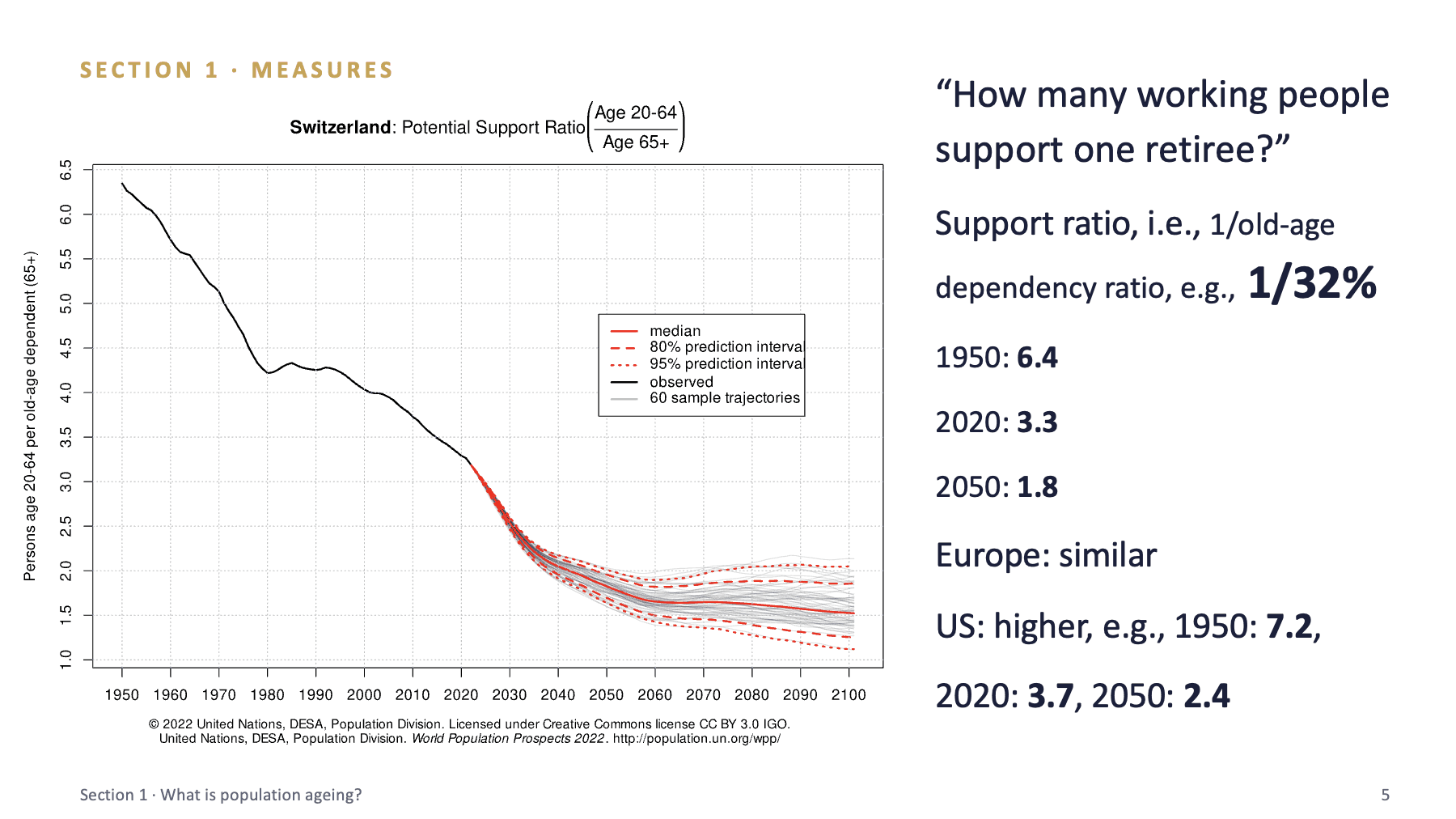
These figures do not mean that a specific number of workers directly pays for each pensioner. But they illustrate the growing pressure on systems that depend on contributions from the working population.
Why are societies ageing?
The first reason is positive: people are living longer.
Medical progress, better nutrition and improvements in public health have significantly increased life expectancy. In Switzerland, life expectancy rose by more than two months per year on average between 1950 and 2020.
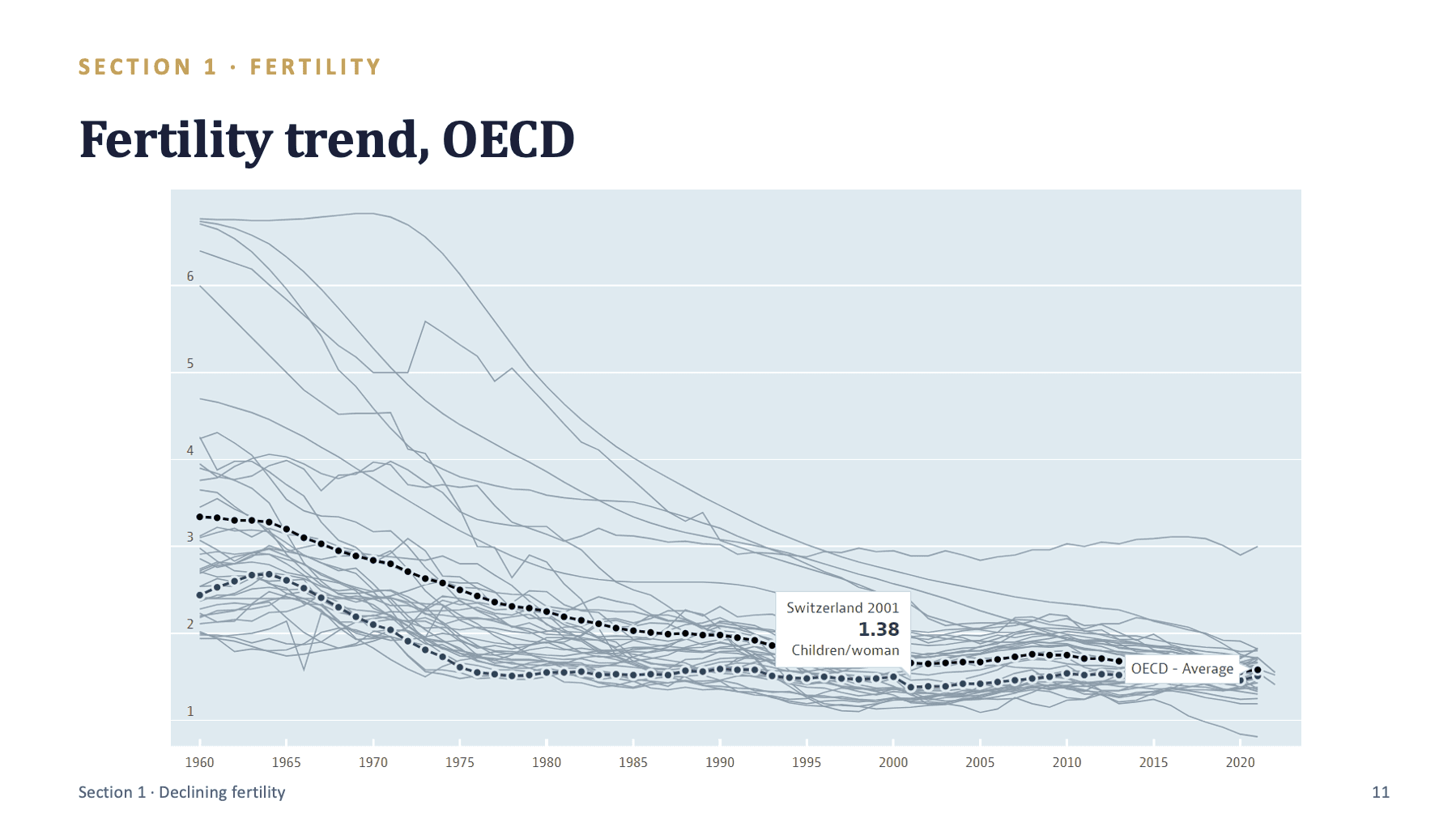
At the same time, fertility has declined. The approximate replacement level is 2.1 children per woman, yet most developed economies now remain below it.
Larger generations are therefore entering retirement while smaller generations replace them in the workforce.
Migration can slow this process by attracting younger workers, but it does not make the underlying demographic transition disappear.
OECD fertility-rate trend:
Institutions designed for a younger world
Many contemporary pension and welfare systems were developed during periods of stronger economic growth, larger families and much younger populations.
Under those conditions, governments and employers could make promises that are becoming increasingly difficult to maintain.
Public pension systems often operate on a pay-as-you-go basis: contributions made by today’s workers finance the pensions of today’s retirees. When the number of workers declines relative to the number of retirees, pressure on the system increases.
One response has been a gradual move from guaranteed retirement benefits towards systems in which individuals accumulate and invest more of their own pension savings.
This may improve financial sustainability, but it also transfers more responsibility and risk to individuals.
The central question is therefore not only how much retirement income people should receive, but who should be responsible for providing it: the state, employers or individuals themselves?
The hidden challenge of care
Pensions are only one part of the ageing debate.
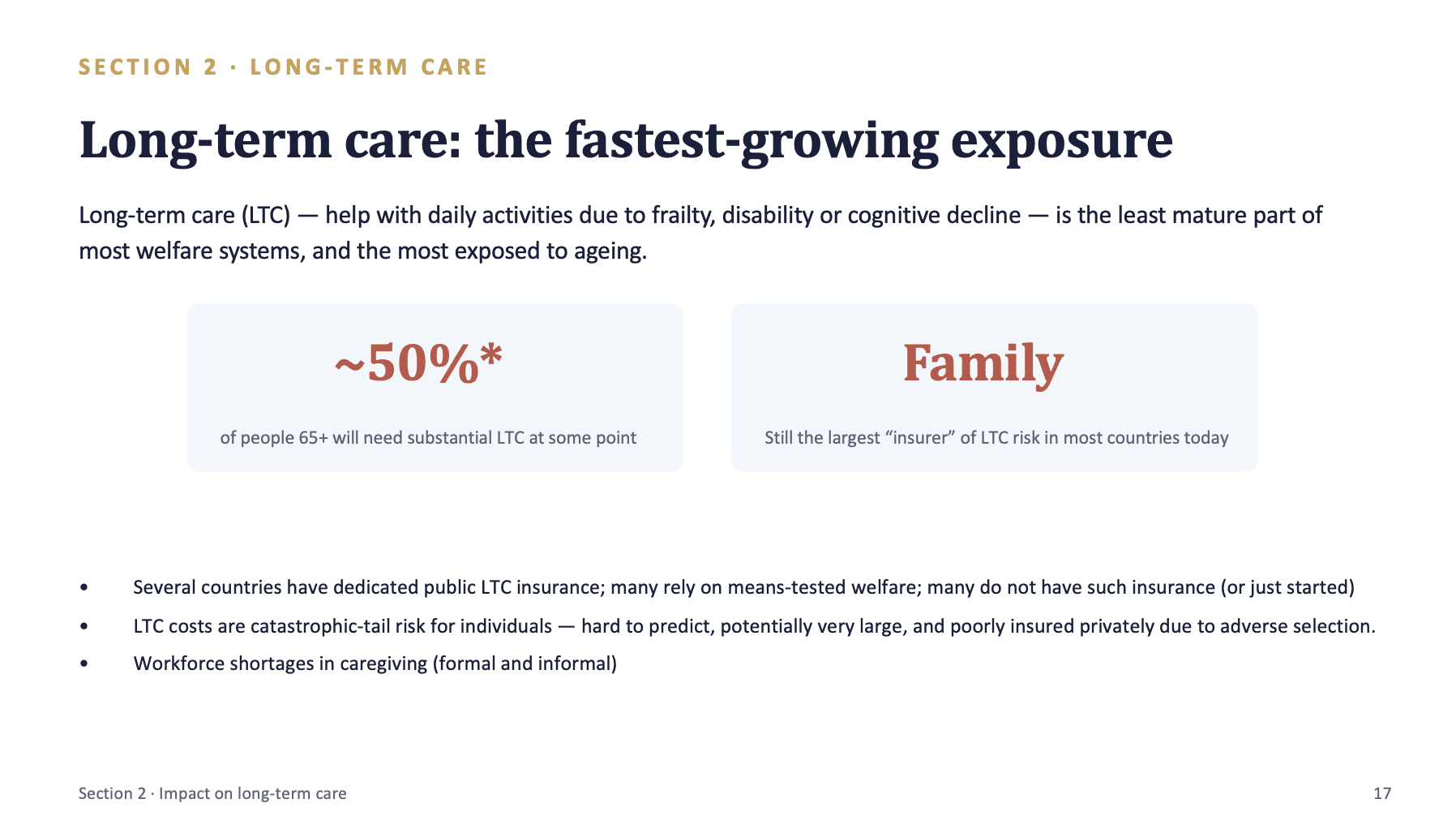
As people live longer, more will require assistance with daily life because of frailty, disability or cognitive decline. Estimates vary, but a substantial proportion of older people are expected to need some form of long-term care.
In many countries, the family remains the main provider of that care.
Long-term care as a growing social risk:
This can create significant financial and emotional pressure. Looking after an ageing parent or partner may involve reducing work, changing career plans or giving up part of one’s independence.
Governments are exploring different responses, including long-term-care insurance, support for care at home, immigration of care workers and new technologies such as assistive robotics and remote monitoring.
However, care is not simply a technical or financial service. It remains deeply human.
Can governments reverse declining fertility?
Many governments have tried to encourage people to have more children through cash payments, parental leave, childcare subsidies and tax incentives.
The results have often been limited.
Countries such as Japan and South Korea show that financial incentives alone may not be enough when families also face long working hours, high housing costs, professional insecurity and unequal expectations around childcare.
Rather than simply convincing people to have more children, governments may need to make it easier for those who already want children to have them without facing disproportionate personal or professional costs.
What can we do about it?
Population ageing is a structural challenge, but that does not mean that individuals and societies are powerless.
At a personal level, one of the first steps is to think more realistically about longevity. Many people underestimate how long they, or their parents, may live and how many years of retirement, healthcare and possible dependence they may need to prepare for.
Financial preparation may therefore become increasingly important. This can include understanding what public and occupational pensions are likely to provide, building long-term savings and investments, and considering tools such as annuities, which can convert part of one’s savings into a regular lifelong income.
Preparation is not only financial. Investing in health earlier in life may be one of the most effective ways to preserve independence later on.
Families may also need to have conversations that are often postponed: where parents hope to live as they grow older, what support they may need, what resources are available and who might eventually take responsibility for their care.
At a societal level, governments will need to reconsider how responsibility is shared between the state, employers, families and individuals.
Pension systems may need to become more transparent and adaptable. Healthcare systems may need to invest more in prevention and chronic-disease management. Long-term-care systems will need to provide families with greater support.
Technology and migration may help address shortages in the care workforce, while better childcare, housing and employment policies may make it easier for people who want children to have them.
None of these measures offers a complete solution on its own.
But together, they point towards a simple principle: ageing should be prepared for long before old age begins.
Longer lives are one of society’s greatest achievements. The challenge is to ensure that our institutions, families and personal choices evolve with them.
Reflections from a Group 54 conversation with Cheng Wan, Postdoctoral Researcher at ETH Zürich
Behind population ageing lie fundamental questions about pensions, care, work and responsibility across generations.
People are living longer. Fewer children are being born. Across much of the world, the balance between younger and older generations is gradually shifting.
This transformation is commonly described as population ageing. But behind this simple expression lies a much wider set of questions about pensions, healthcare, economic growth, family life and the organisation of society itself.
For Group 54’s first online conversation, we welcomed Cheng Wan, Postdoctoral Researcher at ETH Zürich, whose research focuses on population ageing, retirement, health risks, long-term care, fertility and labour.
The discussion offered an introduction to some of the forces behind ageing societies, the challenges they create and the choices that governments, families and individuals may increasingly have to make.
Fewer workers for every older person
One of the clearest ways to understand population ageing is to compare the number of older people with the working-age population.
In Switzerland, there were approximately 6.4 working-age people for every person over 65 in 1950. By 2020, this ratio had fallen to around 3.3. By 2050, it is projected to be closer to 1.8.
Similar developments are expected across Europe.
Japan is already further along this path. Its ratio has fallen from more than ten working-age people per older person in 1950 to approximately 1.8 today.
Japan and Switzerland's changing support ratios:
These figures do not mean that a specific number of workers directly pays for each pensioner. But they illustrate the growing pressure on systems that depend on contributions from the working population.
Why are societies ageing?
The first reason is positive: people are living longer.
Medical progress, better nutrition and improvements in public health have significantly increased life expectancy. In Switzerland, life expectancy rose by more than two months per year on average between 1950 and 2020.
At the same time, fertility has declined. The approximate replacement level is 2.1 children per woman, yet most developed economies now remain below it.
Larger generations are therefore entering retirement while smaller generations replace them in the workforce.
Migration can slow this process by attracting younger workers, but it does not make the underlying demographic transition disappear.
OECD fertility-rate trend:
Institutions designed for a younger world
Many contemporary pension and welfare systems were developed during periods of stronger economic growth, larger families and much younger populations.
Under those conditions, governments and employers could make promises that are becoming increasingly difficult to maintain.
Public pension systems often operate on a pay-as-you-go basis: contributions made by today’s workers finance the pensions of today’s retirees. When the number of workers declines relative to the number of retirees, pressure on the system increases.
One response has been a gradual move from guaranteed retirement benefits towards systems in which individuals accumulate and invest more of their own pension savings.
This may improve financial sustainability, but it also transfers more responsibility and risk to individuals.
The central question is therefore not only how much retirement income people should receive, but who should be responsible for providing it: the state, employers or individuals themselves?
The hidden challenge of care
Pensions are only one part of the ageing debate.
As people live longer, more will require assistance with daily life because of frailty, disability or cognitive decline. Estimates vary, but a substantial proportion of older people are expected to need some form of long-term care.
In many countries, the family remains the main provider of that care.
Long-term care as a growing social risk:
This can create significant financial and emotional pressure. Looking after an ageing parent or partner may involve reducing work, changing career plans or giving up part of one’s independence.
Governments are exploring different responses, including long-term-care insurance, support for care at home, immigration of care workers and new technologies such as assistive robotics and remote monitoring.
However, care is not simply a technical or financial service. It remains deeply human.
Can governments reverse declining fertility?
Many governments have tried to encourage people to have more children through cash payments, parental leave, childcare subsidies and tax incentives.
The results have often been limited.
Countries such as Japan and South Korea show that financial incentives alone may not be enough when families also face long working hours, high housing costs, professional insecurity and unequal expectations around childcare.
Rather than simply convincing people to have more children, governments may need to make it easier for those who already want children to have them without facing disproportionate personal or professional costs.
What can we do about it?
Population ageing is a structural challenge, but that does not mean that individuals and societies are powerless.
At a personal level, one of the first steps is to think more realistically about longevity. Many people underestimate how long they, or their parents, may live and how many years of retirement, healthcare and possible dependence they may need to prepare for.
Financial preparation may therefore become increasingly important. This can include understanding what public and occupational pensions are likely to provide, building long-term savings and investments, and considering tools such as annuities, which can convert part of one’s savings into a regular lifelong income.
Preparation is not only financial. Investing in health earlier in life may be one of the most effective ways to preserve independence later on.
Families may also need to have conversations that are often postponed: where parents hope to live as they grow older, what support they may need, what resources are available and who might eventually take responsibility for their care.
At a societal level, governments will need to reconsider how responsibility is shared between the state, employers, families and individuals.
Pension systems may need to become more transparent and adaptable. Healthcare systems may need to invest more in prevention and chronic-disease management. Long-term-care systems will need to provide families with greater support.
Technology and migration may help address shortages in the care workforce, while better childcare, housing and employment policies may make it easier for people who want children to have them.
None of these measures offers a complete solution on its own.
But together, they point towards a simple principle: ageing should be prepared for long before old age begins.
Longer lives are one of society’s greatest achievements. The challenge is to ensure that our institutions, families and personal choices evolve with them.
Related News
Related News


SEP 1, 2026
From Invention to Adoption: Nicolas Henchoz on What Makes Innovation Last
Read More
Read more

AUG 6, 2026
Blockchain Beyond the Hype: Where Is the Technology Really Creating Value?
Read More
Read more

JUL 23, 2026
Our First Two Conversations at Group 54
Read More
Read more